
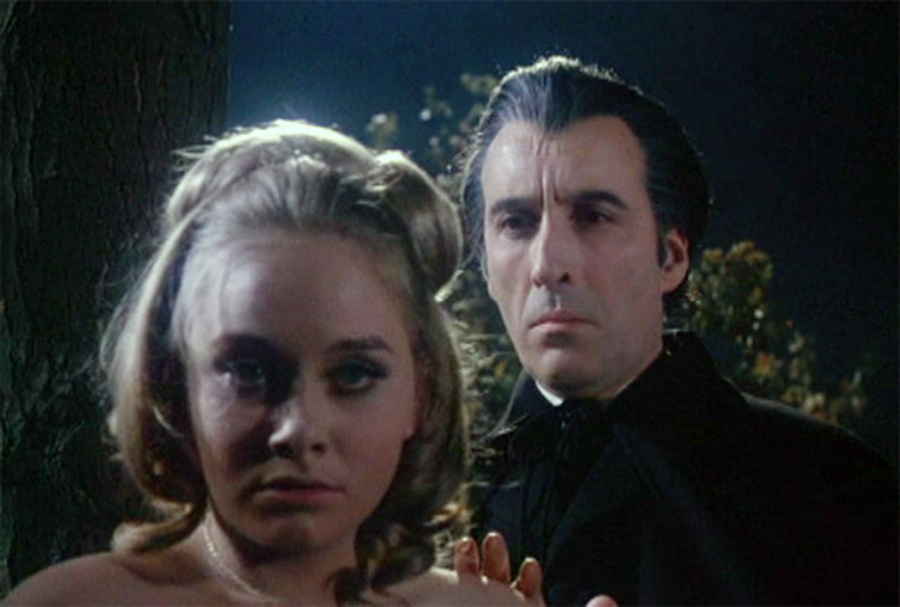
I grew up in a dull and depressing suburb of South East London, England. One of my activities as an enthusiastic young horror fan was to watch the BBC’s weekend late-night broadcasts of Hammer films. I had found my Gothic horror comfort zone to help me combat this monotony and gloom during the pre-internet era of the 1990s.
My earliest memory of Count Dracula is the portrayal by Sir Christopher Lee (1922 – 2015) – the screen icon of the fantastical and macabre. He brought Bram Stoker’s legendary prototypical vampire vividly to life. He had a towering and intimidating physical presence; he delivered what few lines he had ice-cold; he made elegant gestures; he made threatening stances; and he went into sadistic bloodthirsty rages. Lee’s interpretation of this evil, fanged, bloodsucking, and supernatural villain, made him MY Dracula.
The first, third, and fourth instalments in the Dracula series all starred Christopher Lee in the eponymous role. Dracula (Horror of Dracula, 1958) and Dracula: Prince of Darkness (1966), both directed by Terence Fisher, and Dracula Has Risen from the Grave (1968) helmed by Freddie Francis, are all stellar. But my introduction to Lee’s take on the vampiric antagonist was the direct sequel, Taste the Blood of Dracula (1970), from Hammer newcomer Peter Sasdy. At the time, I was enamoured with it, but this is not my nostalgic love letter to it. As I grew older and learned more about film, I was eventually able to take off my rose-tinted glasses, and I could see that this is where the franchise started to show signs of rot.

Sasdy’s direction is energetically inventive: the film is darkly atmospheric; it has a gritty tone; and, for the time, it pushed the envelope with its explicit gore and nudity. The cinematography features slick visuals by Arthur Grant (1915 – 1972). Hammer’s genius production values on such low budgets are on display with a typically lavish look, thanks in no small part to the art direction by Scott MacGregor (1914 – 1971) and the costume design by Brian Owen-Smith. The score by composer James Bernard (1925 – 2001) is robust and melodic.
Taste the Blood of Dracula is set in Victorian London, and in the contrast of its safe rich upper-class life and its seedy underbelly of vice and immorality. The first half has compelling themes of sexual repression and the tensions between elder conservative moral hypocrisy and rebellious exuberant youth. Unfortunately, due to the forced rewrites imposed on screenwriter Anthony Hinds (1922 – 2013), the next half does not live up to it. It descends into an illogical narrative. Not only does it undermine the great talent of Christopher Lee, but also that of Ralph Bates (1940 – 1991), who plays the depraved young aristocrat, Lord Courtley.
The prologue takes place during the climax of Dracula Has Risen from the Grave, in which Dracula was destroyed once again. This is seamlessly edited with the new footage for a clever retcon. Weller (Roy Kinnear, 1934 – 1988) is an English antique dealer who has been traveling through Eastern Europe. He stumbles upon Dracula’s destruction. When the Prince of Darkness has died and disintegrated, Weller collects his dried blood, cloak, pendent, and ring.

During the title sequence, the setting changes to London, and we are introduced to three middle-aged gentlemen: William Hargood (Geoffrey Keen, 1916 – 2005); Jonathan Secker (John Carson, 1927 – 2016); and Samuel Paxton (Peter Sallis, 1921 – 2017). They pose as pillars of the community, and they have formed a triumvirate for charity work, meeting on the last Sunday night of every month. They are actually hedonistic sexual deviants, and this is when they go to a brothel for prohibited thrills to escape the tedium of their routine lives.
In the same sequence, we meet their teenage children. Alice Hargood (cult horror icon Linda Hayden, The Blood on Satan’s Claw, 1971) and Paul Paxton (Anthony Higgins) are in love, but Alice’s father William forbids it. Paul’s sister Lucy (Isla Blair) and Jeremy Secker (Martin Jarvis) are lovers. While this younger cast gives decent performances, and they portray nice people, these characters are bland.
William is an overbearing bully who is cruel to Alice. He chastises his daughter for just being a sexually mature young woman and, to his mind, displaying herself in a provocative manner for flirting with Paul, when all it is, is innocent young love. The churchgoer tells her she is behaving like a “harlot in God’s house”, and tells her not to use blasphemy when she uses God’s name in vain. Then later that night, the mean and hypocritical prick cheats on his loving wife Martha (Gwen Watford, 1927 – 1994) with prostitutes.

At the brothel, the self-assured Lord Courtley bursts in, during a cabaret performance involving a prostitute dancing with a snake, put on for the three men. Courtley clicks his fingers and he is immediately tended to by one of the girls, despite the objections of the brothel keeper, the camp, Felix (Russell Hunter, 1925 – 2004). The men are intrigued by Courtley, so they ask Felix about him. He is the son of a wealthy lord who disowned him and cut off his allowance for celebrating Black Mass in the family chapel several years ago. The girls working in the brothel are under his spell, so they take care of him financially. The three men have tried all the debauchery they can imagine and are bored, so they take Courtley to dinner in the hopes of learning more extreme pleasures. He appeals to their darker sides, promising them an experience they will never forget, by selling their souls to the devil, and he persuades them to part with a considerable amount of money. He takes them to Weller’s backstreet dealership, and they purchase Dracula’s belongings and his blood.
They all meet up later that night at an abandoned church for a ceremony. Courtley puts on Dracula’s cloak, he empties the tube containing the fiend’s dried blood into goblets, and he mixes it with his own. When the blood fills the goblets, he tells the men to drink, but they refuse because they are scared. Courtley downs it with no hesitation. He screams, falls to the floor, and pleads to them for help, but they beat him to death. They flee back to their homes and keep what they have done a secret. Back at the church, Courtley’s corpse transforms into the resurrected Dracula, who vows revenge on the men for killing his servant. He uses their children as tools for his vengeance by hypnotising Alice, turning Lucy by biting her, and she turns Jeremy the same way.
Dracula’s motive for revenge makes no sense, because why would he want to go after the men that caused Courtley’s death that enabled his return. He could not have come back otherwise. Furthermore, Dracula does not care about his disciples and human life in general. He feeds on Lucy’s blood and kills her when he has no more use for her, and he tells Alice as much when he is done with her.

Hammer Film Productions co-founder James Carreras (1909 – 1990) wanted Christopher Lee to reprise his role as Dracula. Lee was reluctant to return because he intended Dracula Has Risen from the Grave to be his last. He would only agree to come back for a percentage of American distributor Warner Bros.-Seven Arts’ box office gross, because he knew how popular he and Hammer horror was there. Carreras refused, and he decided to go with a young actor to play a new vampire villain, due to their previous success with The Brides of Dracula (1960). He found just what he was looking for in the handsome and talented newcomer to British television, Ralph Bates. Bates had just wowed critics and audiences playing Caligula in the limited drama series, The Caesars (1968), a Granada production for the ITV network. Anthony Hinds wrote a screenplay that did not feature Dracula at all, in which Lord Courtley would drink the Count’s blood and turn into a vampire.
Warner Bros.-Seven Arts were adamant that Christopher Lee had to return, otherwise, they would pull their funding for the project. Therefore, James Carreras went back to him with a larger offer, and he accepted. However, he would remain vocal about his reluctance to continue playing the role, due to his dissatisfaction with how his character was becoming a parody of himself. Screenwriter Hinds was not happy that Lee had changed his mind, because he had just five days to do an exhaustive rewrite with Dracula replacing Courtley halfway through.
This cuts Ralph Bates’ effective performance far too short. In his just 15 minutes of screen time, he goes from arrogant pleasure seeker, to aggressive, to frightened, and then dead. Bates does not get the chance to give us his potentially classic Hammer horror vampire villain. Christopher Lee does not do much, because he only turns up occasionally to be elegantly menacing, while he controls the minds of the men’s children and directs them to kill their fathers, as he looks on and says little.

The finale seems nonsensical on the surface, because it is not brought up in expository dialogue as a plot point, but a close observation makes it clear. It takes place in the abandoned church, where Paul confronts Dracula to rescue Alice. Paul bars the door with a large cross. Then he clears the altar of the Black Mass instruments put there by Lord Courtley. This deconsecrated the hallowed ground, allowing Dracula – the embodiment of pure evil – to hide here. Paul replaces these with holy materials. He calls for Alice, and she appears with Dracula. Paul tries to repel Dracula with a cross, but the entranced Alice disarms him. When Dracula dismisses her, it breaks his hypnosis. He tries to leave, but he cannot because of the cross barring the door. Then Alice throws a cross on the floor next to him. He climbs to a balcony and throws objects at Paul and Alice, until he backs into a stained glass window depicting a cross. When he breaks the window to escape, suddenly, he hears the Lord’s Prayer recited in Latin. This represents that Paul has re-sanctified the church. Then Dracula turns around, and he sees all the Christian symbolism, which severely weakens him, and he then falls to the newly blessed alter, and to his death, dissolving to dust.
Hammer’s Dracula series was, for the most part, guilty of repetition. This was something they always tried to avoid with their contemporaneous Frankenstein output. It was Baron Victor Frankenstein (Peter Cushing, 1913 – 1994) who always returned, and not the original monster played by Christopher Lee. This is because Frankenstein was the real villain, who gave us a new creature with a different angle to its creation every time, which made each sequel a unique viewing experience. It is a shame Hammer could not make the film they wanted to with Taste the Blood of Dracula. If Warner Bros.-Seven Arts had had the confidence to go ahead without Christopher Lee, it would have been a much-needed fresh take. After all, The Brides of Dracula is one of the finest Gothic vampire horror films. Instead, a riveting first half is squandered by playing it safe for a disappointingly mediocre next half that makes no sense and it relegates both Christopher Lee and Ralph Bates to small roles.


